Scan to BIM Services in USA
Turn registered laser scan and point cloud data into detailed, information-rich BIM models with our Scan to BIM services. We support architects, engineers, contractors, surveyors, and building owners across the USA with scan-based modeling for existing-condition documentation, renovation, retrofit, and project coordination.
Reliable Scan to BIM Modeling Services for US Projects
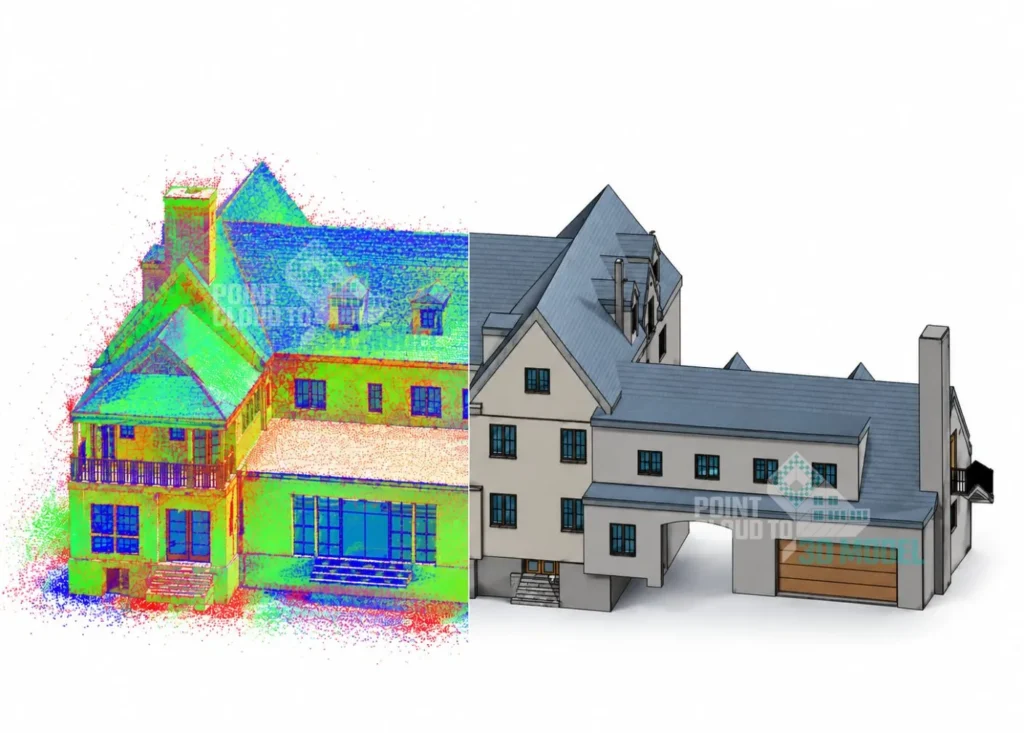
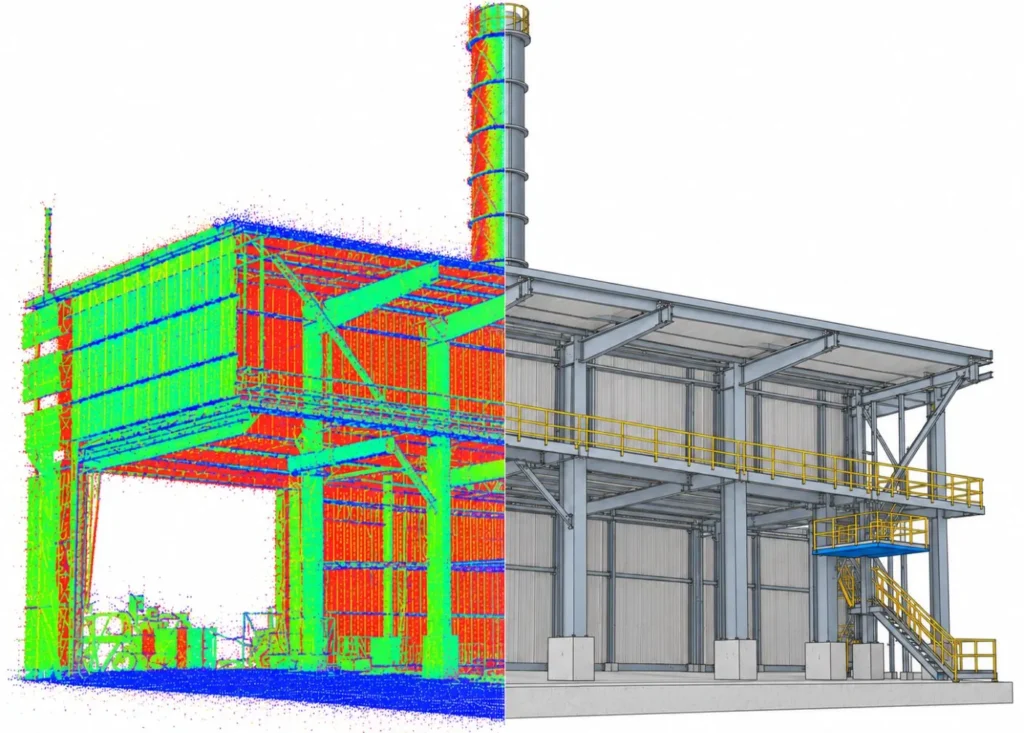
Existing buildings frequently contain differences between original drawings and actual site conditions. Scan to BIM provides a practical way to document these conditions by converting registered laser scan data into structured, three-dimensional BIM models.
Our workflow uses point cloud information as a reference for developing architectural, structural, and MEP elements in Revit. Model scope, geometry, information requirements, and level of development are defined according to the project’s intended use.
Whether your project involves an office renovation, commercial property, industrial facility, residential building, or institutional space, our Scan to BIM services in USA help project teams establish a dependable digital representation of the captured conditions.
Comprehensive Scan to BIM Services
Architectural Scan to BIM
Model visible architectural elements such as walls, doors, windows, floors, ceilings, roofs, stairs, and openings from registered point cloud data.
Structural Scan to BIM
Develop scan-based structural models representing visible columns, beams, slabs, framing, and other agreed structural elements.
MEP Scan to BIM
Model captured mechanical, electrical, and plumbing components, including visible ductwork, piping, equipment, and service routes, according to the agreed scope.
As-Built BIM Modeling
Create BIM representations of existing building conditions for renovation planning, retrofit projects, documentation, and facility-related workflows.
Our Scan to BIM Workflow
Scan Data Collection
The client provides registered laser scan data, relevant drawings, project requirements, and available survey information.
Point Cloud Review and Preparation
Review the supplied data for coverage, registration, alignment, and suitability for the requested modeling scope.
BIM Modeling
Develop the required architectural, structural, and MEP elements using the point cloud as a geometric reference.
Quality Assurance
Review model geometry, alignment, dimensions, levels, and consistency against the supplied scan data, within the agreed tolerances.
Final Delivery
Deliver the agreed BIM model, supporting drawings, and other requested outputs in the specified formats.
Scan to BIM Deliverables for Your Project
Native Revit BIM models (RVT)
IFC models, when included in the agreed scope
Architectural as-built plans, elevations, and sections
Structural BIM models and relevant drawings
MEP BIM models and coordinated views
Model views, schedules, and documentation where required
Existing-condition BIM models for renovation and retrofit
Supporting CAD drawings in DWG or DXF, when requested
Deliverables depend on the project brief, available data, software compatibility, and agreed scope.
Scan to BIM Modeling at Your Required LOD
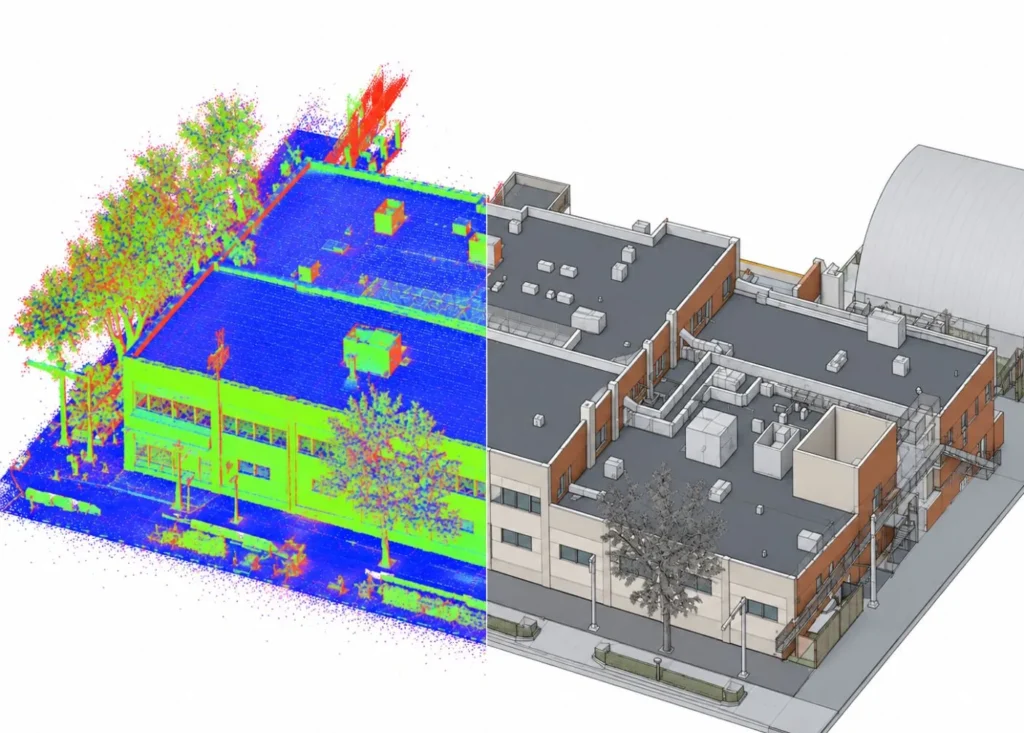
Model detail should match the project’s intended use and agreed level of development. LOD describes the reliability of modeled information — it does not on its own guarantee accuracy, which also depends on scan quality and agreed tolerances.
LOD 200
Generalized Model
Approximate geometry and locations for preliminary planning and conceptual coordination.
LOD 300
Detailed Model
Accurate modeled geometry and locations suitable for agreed design, documentation, and coordination purposes.
LOD 350
Coordination-Level Detail
Additional interfaces and relationships between building elements for more detailed multidisciplinary coordination.
LOD 400
Fabrication-Level Detail
Detailed element geometry and information where fabrication or installation requirements are specifically included in the project scope.
LOD 500
Verified As-Built Information
Field-verified or otherwise validated as-built information, only where the necessary verification data and requirements are available.
Scan to BIM Solutions for Diverse Building Projects
Deliverables depend on the project brief, available data, software compatibility, and agreed scope.
Commercial Buildings
Residential Properties
Industrial Facilities
Healthcare Buildings
Educational Institutions
Hospitality and Retail
Historic and Heritage Buildings
Offices and Institutional Facilities
Why Choose Scan to BIM for Your Project?
Better Existing-Condition Documentation
Create a structured digital reference from captured site conditions.
More Informed Renovation Planning
Understand visible geometry and spatial constraints before designing modifications.
Improved Multidisciplinary Coordination
Support coordination between architectural, structural, and MEP teams using agreed model information.
Reduced Dependence on Outdated Drawings
Use scan-based information to help identify differences between recorded drawings and captured site conditions.
Reusable Digital Building Information
Support future design updates, facility planning, and other workflows when the model's scope and information are suitable.
Compatible with Common Point Cloud and BIM Workflows
Point cloud input formats
E57
RCP
RCS
PTS
PTX
LAS
LAZ
XYZ
PLY
Subject to file compatibility and project requirements.
BIM and CAD deliverables
RVT
IFC
DWG
DXF
And other agreed formats where supported.
Typical tools include Autodesk ReCap Pro, Autodesk Revit, and AutoCAD, as appropriate to the project. Software names are trademarks of their owners.
A Practical BIM Modeling Partner for US AEC Teams
We work with project teams to establish a clear modeling scope, review the available scan data, and develop BIM deliverables aligned with their project requirements.
Clearly defined modeling scope and deliverables
Project-specific LOD and information requirements
Quality checks against supplied scan data
Communication throughout the modeling process
Confidential handling of project information
Delivery in agreed software and file formats
Start a project
Request a Free Scan to BIM Quote
Fill in your project details. Submitting opens an email to our team with your details filled in — attach point cloud samples or share a download link in that email.
- +1 757 656 3274
- +44 7360 267087
- +91 6350202061
- enquiries@pointcloudto3dmodel.com
NDA Available
FAQ
Frequently Asked Questions About Scan to BIM Services in USA
What level of accuracy is required for Scan to BIM models used in US commercial building renovations?
The required accuracy depends on the building’s intended use and the level of detail needed for design and construction. For commercial renovations, healthcare facilities, industrial buildings, and MEP retrofit projects, clients typically require accurate architectural, structural, and MEP geometry that reflects verified existing conditions. The USIBD Level of Accuracy (LOA) specification can help define measurable tolerances, while BIMForum LOD establishes the required level of model development. Both should be agreed upon before modeling begins.
Can you convert laser-scanned point clouds into Revit models following US BIM standards and project requirements?
Yes. Registered laser scan data can be converted into Autodesk Revit models following the client’s BIM Execution Plan (BEP), project modeling standards, and required LOD. Deliverables can include architectural elements, structural framing, foundations, columns, slabs, mechanical ductwork, plumbing, and electrical systems. Models can also follow project-specific naming conventions, shared coordinates, level structures, and family requirements to support coordination with US-based architects, engineers, and contractors.
Can Scan to BIM services capture existing MEP systems above suspended ceilings in occupied commercial buildings?
Yes. Laser scanning can document visible MEP infrastructure above accessible suspended ceilings, including HVAC ductwork, mechanical piping, cable trays, electrical conduits, and equipment. For occupied buildings, scanning can be planned around operational hours and restricted-access areas to minimize disruption. However, concealed services and elements obstructed by closed ceilings or walls require separate access or investigation before they can be accurately documented.
Can existing Scan to BIM models support renovation, clash detection, and design coordination for US construction projects?
Yes. Existing-condition BIM models developed from registered point clouds can provide a reliable geometric reference for renovation and retrofit projects. Architects and engineers can use them to evaluate existing structural constraints, coordinate new MEP installations, identify spatial conflicts, and plan equipment replacements. Models can be federated with proposed design models in Revit and Navisworks to support clash detection and construction coordination.
What deliverables should US architects and contractors expect from a Scan to BIM project?
Depending on the project scope, deliverables can include native Autodesk Revit (.RVT) models, registered point clouds in E57 or RCP/RCS formats, IFC exports, 2D CAD drawings, floor plans, elevations, sections, and model validation reports. Clients should confirm the required Revit version, coordinate system, US customary or metric units, LOD, LOA, and accuracy acceptance criteria before project commencement.