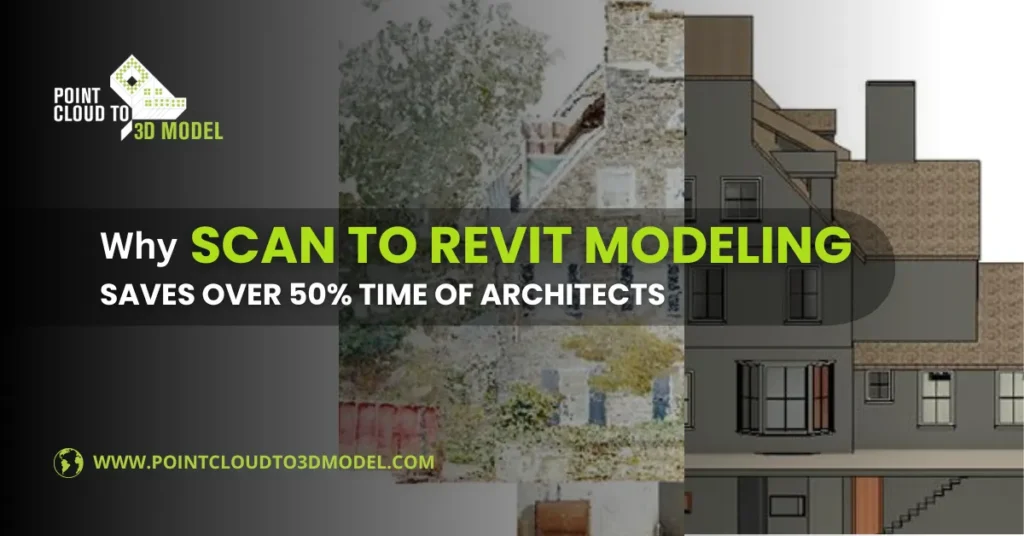
Why Scan to Revit Modeling Saves Over 50% Time of Architects
Introduction
There’s a familiar frustration many architects don’t talk about enough that is working with drawings that almost reflect reality.
You visit a site, take measurements, cross-check old plans, and still… something feels off. A wall is slightly shifted. A beam sits lower than expected. Small inconsistencies, but they add up. And before you know it, hours or days are spent fixing what shouldn’t have gone wrong in the first place.
This is where Scan to Revit Modeling quietly changes the equation.
Instead of starting with assumptions, you begin with accurate site data captured through laser scanning. No guesswork, fewer revisions, and far less time spent going back and forth between site and model.
And when this approach is applied consistently, the time savings are not marginal—they can reach up to 50% across design and documentation phases.
What is Scan to Revit Modeling?
At its core, Scan to Revit Modeling is the process of converting real-world site conditions into an accurate digital model inside Revit.
Using laser scanning technology, millions of data points are captured from a physical space. This data forms what’s known as a point cloud. From there, the point cloud is interpreted and modeled into a structured BIM environment.
You might hear it referred to in slightly different ways:
- Laser Scan to Revit
- Revit Point Cloud Modeling
- 3D Scan to Revit Modeling
Despite the different terms, the objective remains the same: that is to translate physical conditions into a reliable, usable Revit model. And that reliability is what changes how architects work.
Traditional Modeling vs Scan to Revit Workflow
Let’s take a step back and look at how things are typically done.
Challenges in Traditional Methods
In conventional workflows, capturing existing conditions involves:
- Manual site measurements
- Reviewing outdated or incomplete drawings
- Multiple site visits for verification
Even with careful effort, errors tend to slip through. A missed dimension here, a misalignment there and suddenly, revisions become unavoidable.
There’s also the time factor.
Site visits take time. Re-measuring takes time. Fixing errors during later stages? That takes even more time.
Advantages of Scan to Revit Modeling
Now compare that with a Scan to Revit Modeling workflow:
- Accurate point cloud data captures the site as it actually exists
- Reduced manual work minimizes human error
- Faster turnaround allows teams to move into design earlier
It is not just faster but it is more predictable. And that predictability is what architects value most when deadlines are tight.
How Scan to Revit Modeling Saves Time
The time savings don’t come from one single factor. They come from a series of small efficiencies that, together, make a noticeable difference.
1. Accurate Data Capture from the Start
When you begin with precise scan data, a lot of uncertainty disappears.
There’s no need to question whether a dimension is correct or if a structural element is slightly misaligned. The data reflects actual site conditions.
This reduces:
- Design revisions
- Coordination issues
- Late-stage surprises
And when revisions decrease, timelines naturally shorten.
2. Faster Conversion to BIM Models
Once the scan is complete, the data is converted into a usable Revit model.
This process supports Point Cloud to BIM workflows, where raw scan data becomes structured, intelligent geometry.
Instead of building models from scratch, architects work with a ready reference that reflects real conditions. That alone saves a significant amount of modeling time.
3. Reduced Site Visits
One of the less obvious advantages is the reduction in site visits.
With a detailed point cloud available, architects can:
- Review site conditions remotely
- Take measurements directly from the model
- Verify design decisions without returning to site
This is especially valuable for projects in different cities or countries, where travel can slow down progress.
4. Improved Design Efficiency
There’s also a shift in how design decisions are made.
When the base model is accurate:
- Visualization improves
- Coordination becomes clearer
- Decisions are made faster
Instead of spending time validating information, architects can focus on design intent.
And that’s where real productivity gains happen.
Key Benefits for Architects and AEC Professionals
Beyond time savings, Scan to Revit Modeling offers several practical advantages:
- High precision modeling ensures reliable outputs
- Improved collaboration across disciplines using a shared BIM model
- Better planning for renovation and retrofit projects
It also integrates seamlessly with broader Scan to BIM Services, making it easier to manage complex projects from start to finish
Applications of Scan to Revit Modeling
This approach is particularly effective in projects where existing conditions matter.
Common applications include:
- Renovation and refurbishment projects
- Heritage and historic documentation
- Facility management and asset tracking
- Clash detection and coordination
In each case, accuracy is not optional, it’s essential.
While the concept is straightforward, execution requires experience.
Handling large point cloud datasets, interpreting scan data, and building clean Revit models is not something that can be rushed.
Professional Scan to Revit Services providers bring:
- Expertise in managing complex scan data
- Access to advanced tools and workflows
- Faster and more reliable project delivery
The difference often shows in the final model, how clean it is, how well it coordinates, and how useful it is for downstream work.
Conclusion
At a glance, Scan to Revit Modeling might seem like just another step in the BIM process.
But in practice, it reshapes how projects begin.
By replacing assumptions with accurate data, it reduces errors, minimizes rework, and allows architects to move forward with greater confidence. The result is not just improved accuracy but measurable time savings, often up to 50%.
And in an industry where time directly impacts cost and delivery, that shift is hard to ignore.
Read More: 7 Trends in Point Cloud to CAD Modeling You Can’t Ignore in 2026
FAQs
It eliminates manual measurements, reduces errors, and speeds up the design process by providing highly accurate digital models, saving up to 50% of project time.
Industries such as architecture, engineering, construction, real estate, and facility management benefit greatly from Scan to Revit modeling.
Yes, it offers high precision by capturing millions of data points through laser scanning, ensuring reliable and detailed models for design and planning.
It is ideal for renovation projects, historic preservation, facility upgrades, and complex structures where accurate existing conditions are essential.
It provides a centralized BIM model that enables architects, engineers, and stakeholders to collaborate efficiently with accurate and up-to-date data.