
Point Cloud Data Applications in Renovating Historical Buildings
Introduction
There is something special about walking into an old building. The uneven floors, the smell of aged wood, the way sunlight seeps through narrow windows. You can almost feel the long years pressing against you. Now, if you are the one responsible for bringing that space back to a usable built asset then that’s an interesting job.
Renovating historical buildings is not like building something new. You are dealing with fragile structures, missing drawings, and sometimes, walls that have been patched up so many times they no longer match the original plans. Even measuring them can feel like detective work.
That’s where Point Cloud Data quietly changes the game. It lets restoration teams capture a structure exactly as it stands, every crack, curve, and uneven surface without laying a single finger on it. This article looks at how Point Cloud Data is reshaping the renovation of historical and heritage buildings, from digital documentation to as-built modeling and everything in between.
What is Point Cloud Data?
Even though Point Cloud Data doesn’t initially appear glamorous, you’ve undoubtedly seen it if you’ve ever seen a 3D scan of an old church or monument. Each of the millions of tiny dots that make up this dense collection represents a distinct coordinate in space. When combined, they create a digital representation of the physical world. The lovely thing about these scans is that they are non-invasive and originate from laser scanners or photogrammetry setups. You don’t have to touch fragile decorations or scale precarious scaffolding. The scanner simply reads the surface with light, collecting exact spatial data.
For historical sites, that matters a lot. Many monuments can’t handle even mild disturbance. Point Cloud Data allows architects to “see” every corner, ceiling curve, or statue contour safely like a full-scale 3D memory of the site, accurate down to millimeters.
What are the Challenges in Renovating Historical Buildings?
Anyone who’s ever worked on an old building knows, nothing goes as planned.
- Missing or Inaccurate Documentation
Many historic sites lack up-to-date drawings. Sometimes, the only reference is a faded sketch or a partial survey from decades ago. - Structural Wear and Odd Geometry
Walls aren’t perfectly straight, floors slope, and arches lean. Trying to rebuild or repair without accurate data becomes an exercise in educated guessing. - Safety and Accessibility
Surveying narrow towers or unstable ceilings is risky. Even walking through some areas can be unsafe, especially after years of neglect. - Preserving Authenticity
Perhaps the toughest part, every modification must respect the original craftsmanship. One wrong assumption, and you alter the very identity you’re trying to preserve.
That’s why Point Cloud Data feels like a small miracle. It gives restoration teams the confidence to make precise, respectful decisions without gambling with history.
Applications of Point Cloud Data in Renovation Projects
3D Documentation and Digital Preservation
The first thing most teams do after scanning is create a digital twin — a permanent 3D record of the structure. Think of it as an archive that captures not just measurements but the building’s personality. It’s especially valuable for sites at risk of damage from weather or urban development. Even if the structure changes later, the digital record keeps its story intact.
Accurate As-Built Modeling
Here’s where scan to BIM comes into play. Once the point cloud is processed, it’s converted into a 3D model using Revit or similar software. These as-built models help architects visualize the real geometry, no assumptions, no distortions. Planning restoration work becomes faster, cleaner, and based entirely on fact.
Structural Assessment and Deformation Analysis
By comparing multiple scans taken months or years apart, engineers can detect movement or structural stress. Is a wall bowing out more than before? Is the floor sinking slightly? These subtle shifts are often invisible to the naked eye but can reveal a lot about a building’s health.
Clash Detection and Restoration Planning
Integrating new systems — lighting, wiring, HVAC — into a centuries-old structure is like threading a needle blindfolded. BIM models derived from point clouds make clash detection possible before anyone touches the site. That means fewer surprises, fewer delays, and a restoration that stays true to the original layout.
Virtual Restoration and Visualization
And then there’s the visual side of things. With point cloud-based models, restoration teams can create realistic visualizations — even VR walkthroughs — to show how a restored building might look. It’s not just useful for presentations; it helps secure approvals from heritage boards and investors who need to “see” the outcome before giving a green light.
Benefits of Using Point Cloud Data in Historical Renovation
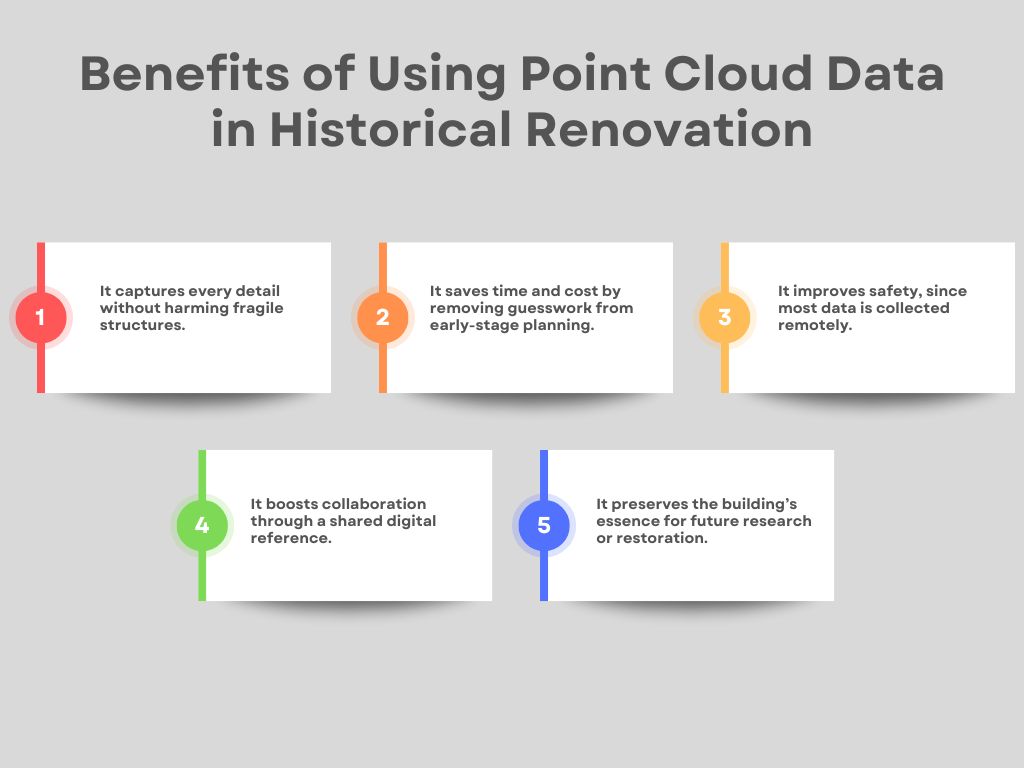
Point Cloud Data doesn’t just make work easier, it makes it smarter.
- It captures every detail without harming fragile structures.
- It saves time and cost by removing guesswork from early-stage planning.
- It improves safety, since most data is collected remotely.
- It encourages collaboration, giving everyone—from historians to engineers—a shared digital reference.
- It preserves the building’s essence for future research or restoration.
Essentially, it turns restoration into a process guided by truth, not assumptions.
Workflow: From Point Cloud to BIM for Heritage Projects
Laser scanning or photogrammetry, frequently with the aid of Leica, Trimble, or FARO scanners, is the first step in a typical workflow. After that, the raw point clouds are processed using programs like FARO Scene or Leica Cyclone, which combine scans into a single, comprehensive dataset.
3D BIM Modeling comes next. Depending on the size of the project, the cleaned point cloud is imported into software such as Revit. Here, BIM specialists meticulously reconstruct the structure, adhering to the precise measurements obtained from the scan.
The outcome? a very precise 3D model that can directly create schedules, sections, and drawings. This serves as the only source of information for heritage projects, directing all restoration choices.
Conclusion
Historical buildings are made of more than bricks—they’re made of stories. When we use Point Cloud Data and convert it through Point Cloud to BIM, it isn’t about adding modern tech to the past. It’s about noticing what time tried to hide. The scanners don’t disturb a single stone, yet they capture every detail—from the curve of a doorway to the gentle tilt of an old wall.
There’s something respectful in that. It helps us understand history without touching it, like listening instead of speaking. In this way, technology doesn’t change history; it helps us remember it accurately. And maybe that is what true preservation really means.