
7 Trends in Point Cloud to CAD Modeling You Can't Ignore in 2026
If you’ve worked on laser scanning or reality capture projects in recent years, you’ve probably noticed that there’s something peculiar about this business. Yes, it’s true that laser scanning and reality capture technology are getting better. Scanners are faster, point clouds are getting denser, and software is getting smarter. Yet there’s a significant aspect of this business that’s still absolutely vital to this process: converting that point cloud data into usable CAD drawings.
Because, you know, a point cloud in and of itself is not necessarily useful to architects, engineers, or construction teams. Yes, it’s true that a point cloud of millions or even billions of points floating in space is a pretty cool thing. But most design and construction teams still need to work with floor plans, sections, elevations, utility plans, structural plans, and all that.
In short, they still need to work with clear and precise CAD drawings.
Point cloud to DWG services, laser scan to CAD, point cloud to AutoCAD conversion are still growing rapidly in the architecture, engineering, and construction industries.
However, the process in 2026 is not the same as it was in 2020 or 2019. It’s getting smarter, and expectations are higher.
Let’s talk about seven trends shaping point cloud to CAD modeling services right now, and why they matter for AEC professionals
1. Reality Capture Is Becoming the Starting Point of Design
Not long ago, laser scanning was used mostly for complex renovation projects or heritage documentation. Today, it’s becoming the default first step for many projects.
Contractors and developers increasingly want existing conditions captured with high accuracy before design work even begins.
Why?
Because manual measurements simply cannot compete with reality capture. Laser scanners can record millions of spatial points within minutes, producing a digital snapshot of the entire environment.
That dataset then feeds directly into scan to CAD services, where technicians convert the point cloud into structured drawings.
For renovation projects, this approach eliminates guesswork. Architects begin design work with precise floor plans and elevations derived from real measurements, not assumptions.
And honestly, once teams experience that level of accuracy, it’s hard to go back to tape measures and field sketches.
2. Hybrid CAD + BIM Workflows Are Becoming Standard
There was a time when teams treated CAD and BIM as completely separate workflows.
That distinction is fading.
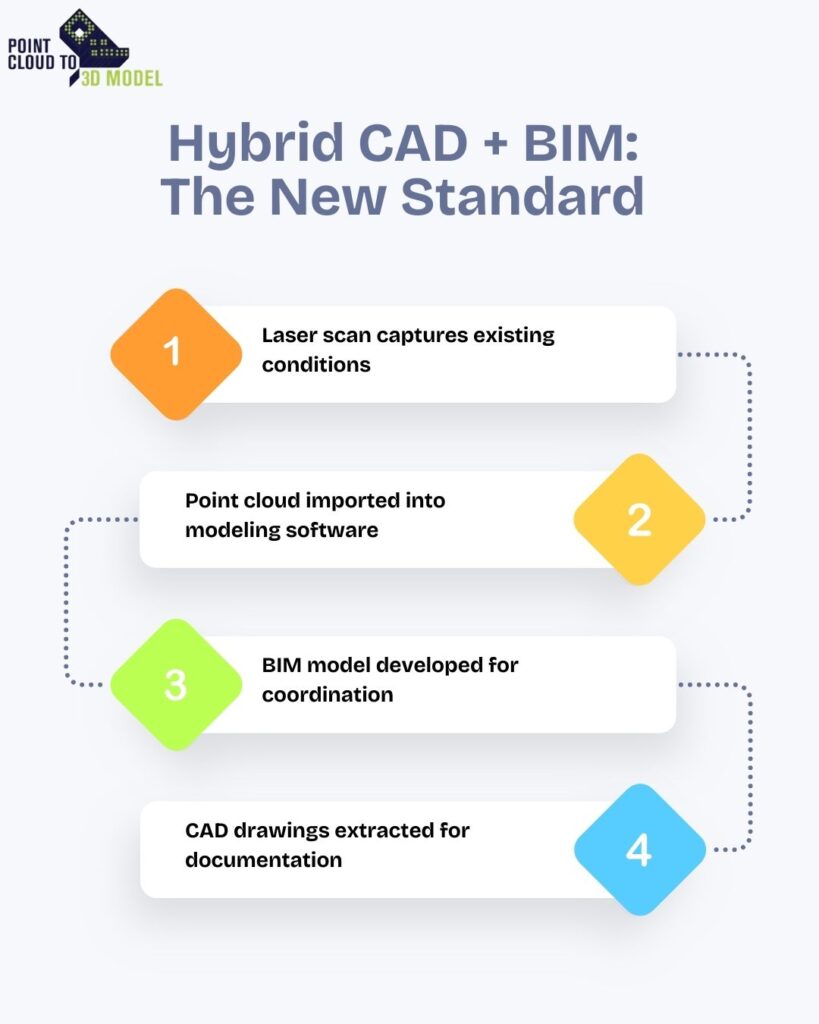
In many modern projects, point cloud data flows through both environments. A typical workflow might look like this:
- Laser scan captures existing conditions
- Point cloud imported into modeling software
- BIM model developed for coordination
- CAD drawings extracted for documentation
This hybrid process allows teams to use the strengths of each environment.
BIM models support clash detection and coordination. CAD drawings provide clear construction documentation.
Many companies offering convert point cloud to CAD modeling services now operate comfortably across both environments, producing deliverables that integrate with larger BIM workflows.
3. Demand for High-Level Detail (LOD) Is Increasing
Another noticeable trend in point cloud to CAD modeling services is the demand for higher levels of detail. A decade ago, many projects required only basic floor plans and elevations derived from scans.
Today, clients often request far more detailed outputs.
These might include:
- Structural steel layouts
- Mechanical equipment locations
- Electrical conduit paths
- Pipe routing systems
- Architectural façade elements
This higher level of detail is driven partly by the increasing use of digital coordination during construction.
Contractors want accurate documentation before fabrication begins. Even small discrepancies can create problems during installation.
As a result, modern point cloud to AutoCAD conversion workflows often involve careful interpretation of complex building systems rather than simple line drafting.
4. AI Is Starting to Assist Point Cloud Processing
Point cloud datasets can be massive. Processing them manually can take significant time.
That’s where artificial intelligence is beginning to assist.
AI tools are increasingly used to:
- Recognize walls and structural elements
- Identify floor boundaries
- Detect pipe networks
- Classify building components
These tools don’t replace human expertise. Experienced technicians still interpret the data carefully, especially when dealing with cluttered environments or incomplete scans.
But AI can accelerate early processing stages, helping teams organize point cloud data faster before converting it into CAD drawings.
In practice, this means laser scan to CAD workflows are becoming more efficient. Projects that once required weeks of manual work can now move much faster.
5. Cloud Collaboration Is Changing How Scan Data Is Shared
Large point cloud files used to be difficult to share.
Many projects involved transferring massive datasets through physical drives or complicated FTP systems.
Today, cloud-based collaboration tools have simplified the process dramatically.
Teams can now upload point cloud datasets to cloud environments where project members, including CAD technicians, can access the data remotely.
This approach has several advantages.
- First, everyone works from the same dataset. Version conflicts disappear.
- Second, project managers can review progress visually without downloading enormous files.
- Third, distributed teams can collaborate more easily.
For companies offering point cloud to DWG services, cloud collaboration allows technicians in different locations to access and process data almost instantly.
It’s one of the reasons global outsourcing of scan-to-CAD workflows has grown significantly.
6. Infrastructure and Industrial Projects Are Driving Demand
Point cloud to CAD modeling services was once associated mainly with buildings. That’s no longer the case. Infrastructure and industrial projects now represent a major portion of scan-to-CAD demand.
Examples include:
- Power plants
- Oil and gas facilities
- Airports
- Rail stations
- Manufacturing plants
These environments often contain dense networks of pipes, equipment, and structural frameworks.
Traditional measurement methods struggle to capture such complexity.
Laser scanning provides a reliable solution, and convert point cloud to CAD services allow engineers to translate that data into usable engineering drawings.
In many industrial projects, accurate CAD documentation becomes essential for maintenance planning and equipment upgrades.
7. Global Collaboration Is Becoming the Norm
Perhaps the biggest change in recent years is how global the scan to CAD workflow has become.
It’s increasingly common for a project to involve:
- Scanning teams on site
- Processing specialists in one country
- CAD technicians in another
- Design teams reviewing drawings elsewhere
This distributed workflow works surprisingly well thanks to improved collaboration tools and standardized CAD practices.
Many architecture and engineering firms now outsource point cloud to AutoCAD conversion to specialized teams who focus exclusively on reality capture documentation.
This arrangement allows design teams to focus on design decisions while dedicated technicians handle detailed drafting.
And because these teams often operate across different time zones, work can progress continuously.
Where Point Cloud to CAD Is Heading Next
Looking ahead, point cloud to CAD modeling services will likely continue evolving alongside advances in reality capture and digital design tools.
Laser scanners are becoming faster and more accurate. Mobile scanning devices are making data collection easier. Software platforms are improving their ability to process massive datasets.
At the same time, the construction industry is embracing digital workflows more than ever before.
Reality capture, BIM coordination, and digital documentation are no longer experimental technologies, they are becoming standard practice.
And somewhere in the middle of that ecosystem sits the essential step of translating raw spatial data into structured engineering drawings.
That’s where scan to CAD services and point cloud to DWG workflows will remain critical.
Final Thoughts
Laser scanning technology may capture the physical world with extraordinary detail, but that data only becomes useful when it’s converted into something engineers and architects can actually work with.
This is where point cloud to CAD modeling services steps in.
As the AEC industry continues to adopt digital technologies, the requirement for accurate laser scan to CAD documentation is only set to rise.
The trends that are currently defining the industry- AI-aided processing, cloud collaboration, CAD-BIM hybridization, and global teams- are making it faster and more accessible than ever.
For professionals in renovation work, infrastructure design, and industrial design, keeping an eye out for these trends is not only desirable but essential.
Read More: Top 5 Challenges When Importing Point Cloud Survey into Revit (And How to Solve Them)